
The technical solution should follow the business workflow—not force the business to work around it.
EBA WP builds and extends WordPress and WooCommerce systems: company websites, online stores, custom plugins, integrations and the technical support required after launch.
Four core services. One shared technical foundation.
A project may use one service or combine several. The purpose of the first discussion is to determine what must be built, what can be retained and where custom development is justified.
WooCommerce & eCommerce development
Online stores, checkout behavior, payments, couriers, orders, customers and integrations.
Company websites & landing pages
Professional presentation websites with clear structure, reusable content and responsive implementation.
Custom WordPress & plugin development
Plugins, integrations, internal tools and automation built around specific operational rules.
Maintenance, support & consulting
Updates, investigation, improvements and technical decisions for an existing WordPress platform.
WooCommerce development beyond the visible storefront.
The customer sees products and checkout. The business depends on pricing rules, payments, delivery, order data, integrations and internal processing continuing to work together.
Architecture, catalog, responsive implementation and launch configuration.
Conditional fields, validation, shipping, payments and business-specific restrictions.
Order workflows, customer context, administration tools and fulfillment support.
Courier services, ERP, invoicing, marketplaces and external APIs.
A professional website should reduce confusion before it asks for contact.
We plan the information structure, visual hierarchy and reusable components before reconstructing the design in WordPress and Elementor.
Information architecture
Pages, navigation and content order based on what visitors must understand.
Responsive visual system
Consistent typography, spacing, cards, calls to action and mobile behavior.
WordPress implementation
Reusable Elementor sections and practical content management for the team.
Technical foundations
Performance, accessibility basics, metadata structure and maintainable configuration.
When the required workflow does not exist, we build the missing technical layer.
Custom development is justified when combining generic plugins creates conflicts, manual work, unclear ownership or a system that still cannot represent the requirement.
Launch is the beginning of the system’s operational life.
WordPress, WooCommerce, integrations and business requirements continue changing. Maintenance should preserve reliability while leaving room for controlled improvements.
Continuous maintenance
Keep the current platform operational and reduce avoidable update or compatibility risk.
- WordPress, plugin and theme updates
- Backups and recovery checks
- Compatibility and issue investigation
- Security and performance corrections
- Incremental improvements after launch
Technical consulting
Make architecture and implementation decisions with clearer technical context.
- Existing-system and plugin-stack review
- Custom development feasibility
- Migration and integration planning
- Technical scope and milestone definition
- Prioritization of corrections and future work
A service becomes easier to choose when the problem is concrete.
These are examples of project situations—not fixed packages. The implementation depends on the current system, data, integrations and business rules.
The checkout cannot represent the business rules.
Shipping, payment or validation behavior requires logic beyond standard settings.
Several plugins overlap and create conflicts.
The current stack duplicates responsibilities but still leaves important gaps.
Orders must synchronize with another system.
ERP, invoicing, courier or marketplace data must move reliably in both directions.
The website is difficult to maintain.
Pages are inconsistent, fragile or dependent on changes that only one person understands.
A manual process needs an internal tool.
Operators repeat the same steps because no suitable administrative workflow exists.
No existing plugin provides the required behavior.
The closest options require unacceptable compromises, workarounds or external handling.
The project does not have to begin from zero.
We can build a new platform, extend an existing one, recover a difficult implementation or remain involved after launch.
Understand first. Define the technical boundary. Then build.
The purpose of the process is not ceremony. It is to reduce incorrect assumptions before they become development cost.
Review the requirement and current system.
Users, data, integrations, constraints and operational consequences.
Establish scope and responsibilities.
Architecture, first-release boundaries, risks, milestones and dependencies.
Implement in controlled stages.
Development, review, compatibility checks and practical acceptance testing.
Deploy and verify the production flow.
Final checks, data handling, configuration and post-launch corrections.
Keep the technical context after delivery.
Updates, support, observation and future improvements where required.
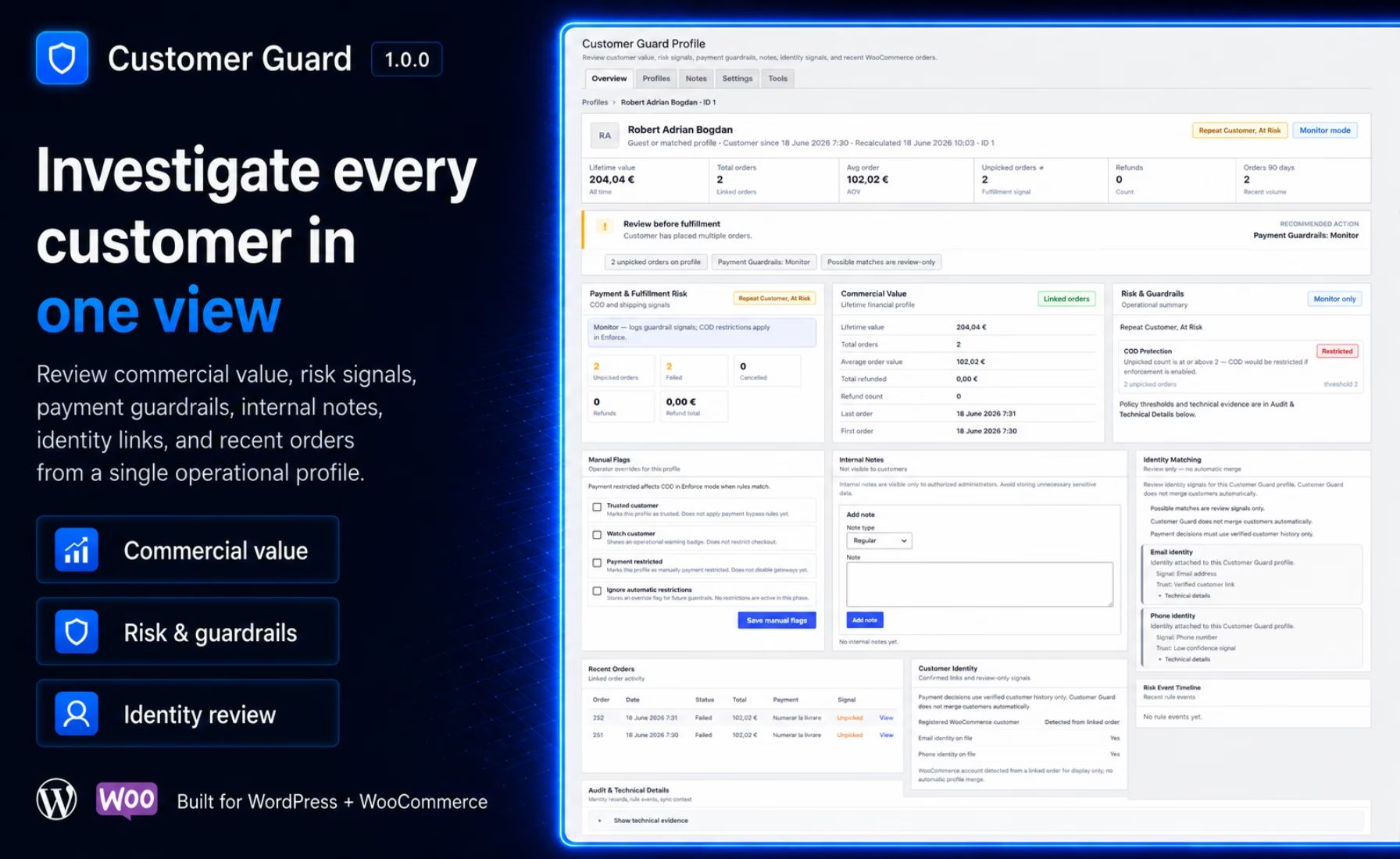

Our own WooCommerce product follows the same standards we apply to client work.
Customer Guard was developed around a real order-processing problem and published through WooCommerce Marketplace. It demonstrates experience with WooCommerce data, admin workflows, payment rules, compatibility and product maintenance.
Describe what exists, what is not working and what the business needs to achieve.
We can use that information to identify the relevant technical direction before discussing implementation.